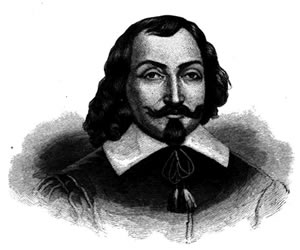
Samuel de Champlain was born in Brouage, France around the year 1567. He became one of the most important explorers in North American and French history and mapped much of Canada and the northeastern United States.
Starting a Career in Exploration
In 1603, Champlain sailed to North America on Francois Grave Du Pont's expedition. The pair and their crew sailed west through the Gulf of St. Lawrence and into the St. Lawrence and Saguenay Rivers. They also explored the misty Gaspe' Peninsula of Quebec. After returning to France, Champlain decided to sail back to Quebec in the hopes of discovering the Northwest Passage, a mythical waterway that would serve as a shortcut from the Atlantic to the Pacific.
Making History for France!
 |
Champlain Route Map |
Champlain returned to Quebec in 1604 on Pierre de Mont's expedition. For the next three years, Champlain explored much of the coast of Nova Scotia, the Bay of Fundy and the coasts of Maine, Rhode Island and Massachusetts. Champlain started his first colony in the New World on Port Royal, Nova Scotia in 1605. In 1608, Champlain started the first permanent French colony in the New World at Quebec (City) on the St. Lawrence River. The colony was started as a fur-trading center. Unfortunately for the French settlers, they were not used to the bitter Canadian winter. Of the 32 settlers in the colony, only nine survived the winter. More colonists would be sent from France to reinforce the colony.
 |
Quebec City Today |
Exploring the Great Lakes Region
In 1609, Champlain helped the Huron Indians fight the Iroquois, which ultimately led to much bitterness between the French and Iroquois. In 1615, Champlain explored much of upstate New York and parts of Ontario and eastern Michigan. Champlain spent the rest of his life managing the settlements at Quebec. He died in 1635, apparently of a stroke.